A while ago, I wrote about "eldergrimming," which is what happens when an inspiring, affirming moment is ruined by an old person. Today I was reminded that it's not just the elderly who are capable of introducing an uncomfortable note of awfulness into a pleasant situation you really didn't expect would turn awful.I was on the streetcar and a mass of tiny children got on. I immediately thought, "I want to kill myself. Very soon, I'm going to want to die." But I soon noticed that the children were implausibly adorable and that their teenage counselor was implausibly attentive (to them, I mean) and resourceful and engaged and funny. The kids were bouncing around in a way that was still cute but on the verge of being not cute at all anymore, and the counselor asked them all the following question, which suddenly and fiercely focused them on something other than starting to no longer be cute: "If you had all the money in the world, what would you spend it on?"Cue head-exploding cuteness explosion. One tiny boy said, "I would spend the money helping other people who need help." Adorable. One girl said, "I would buy Gerrard Square mall." Slightly less adorable—because more commercial and acquisitive—but still acceptable. The tiniest boy of all looked like he'd been hit by a thunderbolt of inspiration and come up with THE BEST IDEA EVER, and he shouted, "I would buy...A CAKE!"By this point, I was smiling widely and feeling generally uplifted. I got up to leave the streetcar, still smiling in a "I am old and sophisticated, but still capable of being softened by the magic of childhood" kind of way, and a sweet-faced girl yelled:"SLAVES! I would buy A LOT OF SLAVES!"And then I went to the grocery store and a sweet-faced elderly woman was really mean to the cashier.
On Tuesday, I went to a distressing and wonderful event: my niece's grade-eight graduation. It was distressing because just a few years ago I saw her being born and now SHE'S GOING TO HIGH SCHOOL, and it was wonderful because she's turned out not half bad.
After she had WON A PRIZE for officially being not half bad and received her diploma, she was poised to go a graduation dance, and so my sister and I reminisced about how awkward and traumatizing it had been to dance to Stairway to Heaven when we were in school (because of the song's ridiculous length and that upbeat, bouncy bit in the middle when you usually stayed with your arms around each other but bobbed about more vigorously). That got me thinking about the Songs of My Youth, and the songs of my grade-eight graduation dance in particular.
My dance took place in the year...I'm pretty sure it was 1990. And that still doesn't seem all that long ago, but Buzzfeed recently had a list called something like "45 Things That Are Crazily and Unbelievably Long Ago About 1999" (a year which, as you'll note, occurred almost a decade after the year I'm talking about) and also, my niece is GOING TO HIGH SCHOOL, so I realize that it was a long time ago and that I have a great deal to share with the younger generation.
I will not, obviously, be able to remember all the songs played by Clarence the DJ at Glenview Senior Public School—I have also managed to forget (1) the names of the boys kicked out of the dance for getting drunk off of some malign mixture of spirits from their parents' liquor cabinets, and (2) the last name of the boy who, at my graduation, told me I looked like a prostitute (I really, really didn't—but he was kind of a dick).
So here they are:
Fast Songs
You Shook Me All Night Long — ACDC
Sweet Child 'O Mine — Guns N' Roses
Mony Mony — Billy Idol
U Can't Touch This — MC Hammer
Bust A Move — Young MC
It Takes Two — Rob Base and DJ E-Z Rock
Joy and Pain —Rob Base and DJ E-Z Rock
Bizarre Love Triangle — New Order
Rock and Roll — Led Zeppelin
Sweet Soul Sister —The Cult
Beds Are Burning — Midnight Oil
Funky Cold Medina — Tone Loc
Red Red Wine — UB40
Faith — George Michael
Mary, Mary — Run–D.M.C.
Slow Songs
Patience — Guns N' Roses
Somebody — Depeche Mode
A Groovy Kind of Love — Phil Collins
Every Rose Has Its Thorn — Poison
Right Here Waiting — Richard Marx
Heaven — Warrant
Heaven — Bryan Adams
Without You — Motley Crue
What It Takes — Aerosmith
Never Tear Us Apart —INXS
I'll Be There For You — Bon Jovi
When I See You Smile — Bad English
Nothing Compares 2U — Sinead O'Connor
Stairway to Heaven — Led Zeppelin
The last song played (I vividly remember thinking, "This is the LAST SONG of my junior-high-school life") was Alphaville's Forever Young, and I also vividly remember thinking, "This song is hilariously inappropriate, because I don't care how old I get as long as aging means I get to leave junior high school." Also, we all thought that song was based on some story about some Swedish teenagers who committed suicide en masse after their prom, so it was a bit depressing. That story appears to be apocryphal, though, which I why I can now be so flippant about it.
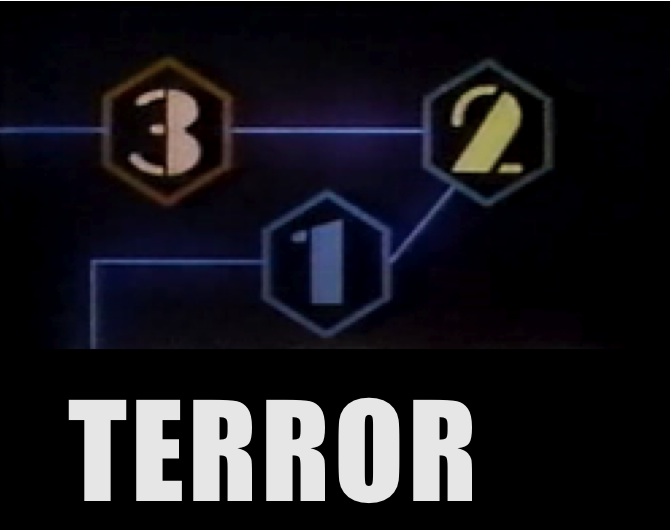
Once again, I'm going to write about something that scared me when I was a kid-- partly because I spent so much of my childhood being terrified of things that this topic has triggered a seemingly endless stream of remembrances, and partly because I've spent the week thinking about how it's possible for a kid to be terrified of a Muppet. The Phantom of the Muppet Show (the ungodly fright puppet I discussed last week) was indeed a phantom who haunted places and people, but he was also surrounded by singing and dancing bundles of adorableness (and also Ethel Merman). My undeveloped brain, dominated by a sense that the world boasted many conspicuous threats, and many things that seemed innocuous and then turned out to be threats, and many children's puppets who wanted to sing and dance and then lie in wait and kill me, was capable of being frightened by Uncle Deadly (understanding the "Deadly" part), but not of correctly receiving and interpreting the very clear "Toddlers! Do not fear! This admittedly terrifying Muppet only draws near because he wants to sing and dance with you!" message (the "Uncle" part). It's not surprising that I was scared by something like Poltergeist when I was a kid. It's a scary movie. It's more surprising that I was so petrified by the following show-within-a-show that even just hearing the theme song was enough to make me want to retreat under my bed and set up house there. The show was called 3-2-1 Contact, and it ostensibly taught kids about science, although it taught me mostly about FEAR AND SUFFERING. I don't remember much about the larger show at all (i.e. I've forgotten most of the science-y bits), but I remember the embedded story, which focused on a group called the Bloodhound Gang. The Bloodhound Gang (proving that liberal, science-education-promoting, public-access-television-viewing parents don't truly love their children and so let them run about unsupervised and learn about scientific principles and near-death experiences) are for some reason allowed to moonlight as private investigators and regularly able to foil villains and their villainous plots by way of things like pinhole cameras. I no longer remember when the Bronze Age was or how to multiply fractions, but thirty or so years later, I still remembered that these kids found a stolen mummy, were thrown into a truck, and were threatened with death by hardened criminals.
Unfortunately, I managed to forget that a) the soundtrack regularly featured the "wah wah wah waaaaah" sound judiciously used by sitcoms to signify that something silly and unexpected has happened, b) the criminals were silly, and c) the children were never scared. I also managed to forget every bit of resourceful science-y-ness the kids used to get themselves out of danger. (Of course, I just watched this again as a 36-year-old and am still not convinced I know how to build and operate a pinhole camera.)
When I was little, I was able to edit out all the signals that were supposed to reassure me that children's television danger was neither truly dangerous nor likely to last very long. I was, though, able to grasp the fact that in emergencies, I would almost certainly be called upon save myself by drawing on my knowledge of things like the Bronze Age or the multiplication of fractions. If I'd been a member of the Bloodhound Gang, I WOULD HAVE DIED IN THE BACK OF THAT TRUCK.
POLITE DISCLAIMER: This site is intended for entertainment purposes only. If you are not entertained, fair enough.
When I was a kid, I often thought of things as being in competition with one another, and of myself as being required to come down on one side or the other. So there was the Rolling Stones vs. the Beatles (Beatles); Star Wars vs. Indiana Jones (Star Wars, although that's just because of how much I liked Star Wars and doesn't mean I didn't also idolize spirited women who could drink men under the table in exotic locales); and Sesame Street vs. the Muppet Show. I realize that Sesame Street and the Muppet Show had various things in common, like everyone who produced them. But I, being a young person who loved the Beatles and Star Wars but perhaps loved judging things even more, felt obliged to make a choice, and it wasn't difficult in the least: it was the Muppets every time.It was partly because the grown-ups on Sesame Street kind of freaked me out. They were overly friendly and it also seemed to me that they talked down to the puppets. Also, it used to make me cry because no one would ever believe that Snuffleupagus existed, even though he'd just been RIGHT THERE.On the Muppets, there was a far more sensible person-to-puppet ratio and less of an emphasis on counting. There was only one problem with the show: it featured a terrifying creature who, because Darth Vader had already claimed my bedroom closet, got into the habit of materializing on my wall. This horrifying, terrifying, sinister Muppet was named Uncle Deadly and he was the Phantom of the Muppet Show.It's funny how impressionable and malleable and defenseless and hysterical a kid's mind is; he seems to have appeared on the show only a couple of times, and yet he had enough of an impact on me that he carved out a piece of the nightmare part of my brain for his own. He turned up first in the company of Vincent Price, who scared me. He then turned up again singing with Ethel Merman, who also undoubtedly scared me. He appeared to various muppets, and scared them, and Kermit thought they'd imagined it all (WHY ARE MUPPETS SO FAITHLESS AND SKEPTICAL?!?), but finally he saw Uncle Deadly for himself and learned that Uncle Deadly used to perform at the Muppet Theatre as Othello before he was killed by critics. I'm sure that episode ended with Deadly becoming friends with everyone and turning out to be a loving and supportive friend, but I blocked that part out. When he turned up on my wall (his eyes would glow - I could actually see his eyes glowing), he was not friendly. I don't know why I didn't just set Darth Vader on him. 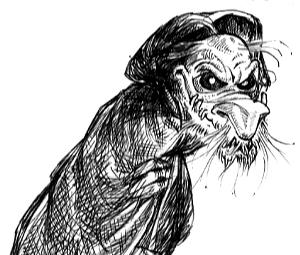 Sketch by Muppet designer Michael K. Frith. Sleep well. POLITE DISCLAIMER: This site is intended for entertainment purposes only. If you are not entertained, fair enough.
So another thing that terrified me when I was a kid was this:
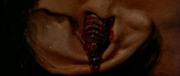
This nightmare was brought to me courtesy of Star Trek II: The Wrath of Khan. The Ceti eel, which I'm sure is a perfectly lovely little creature when it's not busy crawling into people's ears and wrapping itself around their cerebral cortex and then slowly killing them, also looks fetching when emerging from an ear:
It didn't help that the 1980s were the decade of the earwig, at least when it came to the basement of my family home. They skittered around just out of sight. They skittered around in plain sight. They would find cosy places (usually in or around things I liked and had a tendency to want to play with) and curl up there and then wriggle around energetically when they were discovered.
When I was in grade two or thereabouts, I got some lovely small glass bottles from Science City and proceeded to pretend to be a hardboiled detective and take dramatic swigs from them (while writing down secrets notes and smoking a pencil—oldtimey movies on PBS warp children way more than video games and communism) and inevitably the whole thing ended in disaster when I polished off a shot of earwig.
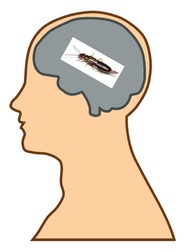
So in public school, I was haunted by the idea that earwigs wanted to get inside my head.
My mother, a resourceful, creative, and patient parent, proved herself to be a veritable genius when responding to my earwig/science-fiction eel-in-brain phobia. She made up a story about a young boy who was very lonely. One day, she said, this boy met a young earwig who was also very lonely. The young earwig then crawled inside the little boy's head. From that point on, they went everywhere together and the two of them became the best of friends.
Bizarrely enough, because of my mother's storytelling intervention, I went from fearing that a devious crawly thing would slither inside my ear to feeling like no human relationship would ever be as intimate or as fulfilling as one between a boy and his brain bug.
POLITE DISCLAIMER: This site is intended for entertainment purposes only. If you are not entertained, fair enough.
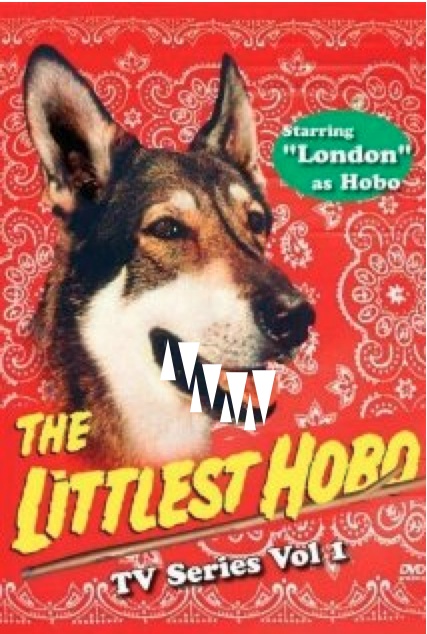
Here's something that scared me when I was six. Next week I will write about another childhood fear (maybe the one that involved something crawling through my ear and into my brain). The Littlest HoboI watched Doctor Who on a regular basis when I was a child, and I was never scared. I was never scared of Daleks, or the Master, or the Cybermen, or the terrible thing that lived underground and was clearly just a number of people concealed inside a giant sock. I was disdainful of all children who were scared of Doctor Who, and who spoke of being creeped out as soon as they heard the opening bars of the theme song. I resolutely ignored the fact that my disdain was rendered ridiculous by my own fear of The Littlest Hobo. Not the dog—I knew he was a wandering canine force for wrong-righting and justice. I'm talking about the show itself. Maybe it was because it featured distressing things happening in and around Toronto; it was certainly because, at least as far as I remember, each and every show featured robbers. Robbers! Torontonian (or at least Ontarian) robbers who climbed up ladders into windows! My memory also tells me they were dressed very much in the manner of an eight-year-old dressing up as a robber for Halloween. They had black turtlenecks, and masks, and sacks to carry off all the things they were planning to take from the bedrooms of the children whose witless parents had left ladders lying around as a irresistible invitation to 1980s robbers.It's not even just that I knew that Torontonian robbers were real and space monsters likely weren't and so apportioned my fear in a sensible manner. I would probably have been able to accept that there were giant walking stones that killed people and evil men with goatees who turned people into action figures. I think maybe I wasn't petrified by those possibilities because if they were possible, so too was a time-traveling , mop-top space scamp with a penchant for jelly babies. And if he existed, it was almost unavoidable that I would at some point end up traveling through time and space with him, earning my keep by acting as a stabilizing influence.What was the compensation for the undeniable existence of robbers? A dog who traveled about south-eastern Ontario occasionally foiling those robbers before promptly deserting whatever child had developed an attachment to him? As much as I was petrified of robbers when I was six, it's possible I was even more petrified of being saved and then rejected by a crime-fighting dog. Maybe tomorrow you'll want to settle down? WHY NOT NOW. POLITE DISCLAIMER: This site is intended for entertainment purposes only. If you are not entertained, fair enough.
I am frequently grateful for the fact that Facebook did not appear until I was well and truly aged. Not because of the fact that I would probably have been made fun of a lot by vicious grade-eight classmates who would then go on to become successful grown-ups with children and pets. Or because Facebook clearly states the number of friends you have and allows for the convenient and unfair comparing of such numbers. No - I am glad it didn't exist because I would have regularly, insistently, and publicly made an ass of myself.
1) I would have posted song lyrics.
When I was in grade eight, I had an assignment that involved public speaking. We were supposed to recite a poem or some song lyrics. "Aha!" I apparently thought. "This is my chance to show my WHOLE ENTIRE CLASS that I am sensitive, introspective and FULL OF UN-IRONIC AND HUMOURLESS PAIN." So after one guy performed "Goodbye, Ruby Tuesday" and another guy did a really quite moving and dramatic interpretation of "Parents Just Don't Understand," I proceeded to stand up and, with total sincerity, recite the words to Simon and Garfunkel's "I am a Rock." That's right. If you don't remember the lyrics off the top of your head, here are some gems: "I've built walls, / A fortress deep and mighty, / That none may penetrate. / I have no need of friendship; friendship causes pain. / It's laughter and it's loving I disdain. / I am a rock, I am an island." Oh, and then there's: "I have my books / And my poetry to protect me; / I am shielded in my armour, / Hiding in my room, safe within my womb. / I touch no one and no one touches me. / I am a rock, I am an island." I concluded with a ringing, "And a rock feels no pain; / And an island never cries," and looked up, fully expecting to see that the eyes of my classmates were now wide with understanding and compassion...It went down pretty much like anyone with any sense and a passing acquaintance with fourteen year olds would expect. They laughed at me. I can't really blame them. The person I DO blame is my grade-eight teacher, WHO ALSO LAUGHED AT ME. Of course, he also brushed his eyebrows before class, so he wasn't totally credible.
If Facebook had existed when I was in grade eight, and in this alternate world I was as deluded and earnest and self-pitying as I was in the real one at that age, every other status update would have been that kind of song.
2) I would have worn clothes.
The other week, I mentioned the fact that I purchased a Ramones t-shirt in grade seven. And I did. I totally did, and I loved it, and I still have it. Unfortunately, I also had and wore other shirts at that age. I recently found a photo of myself from grade seven in which I was wearing a shirt I'm pretty sure I was pretty proud of at the time. It had some bars of Handel's Messiah on it, and it said...wait for it... "Handel With Care." I did not like this shirt in some kind of ironic, hipster way. I was probably on some level convinced that all I needed to do to win over my contemporaries was provide proof that a) I liked classical music, and b) I liked puns.
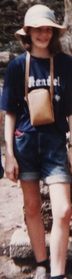 Unfortunately, fate and a stylish camera bag conspired to block the t-shirt's full message. Did I, by the way, feel the need to choose between the hilarious shirt and the floppy hat? I MOST CERTAINLY DID NOT. Facebook would have been the perfect vehicle for proving to an even larger number of people how much I appreciated classical music and puns.
3) I would have chosen totally embarrassing and misleading profile pictures.
I am chatty. I am really quite chatty. I also used to be one of those unfortunate chatty people who do not accept and embrace their own chattiness and instead spend much of their time wishing they could be silent and French and look mysteriously out windows. I would, therefore, probably have filled Facebook with really embarrassing photos of myself looking in a wistful and longing and continental fashion out widows. (And then really disappointed people when I opened my mouth and sounded like a less charming version of the girl from Real Genius.)
If Facebook had existed when I was fourteen, this is what you would have seen:
POLITE DISCLAIMER: This site is intended for entertainment purposes only. If you are not entertained, fair enough.
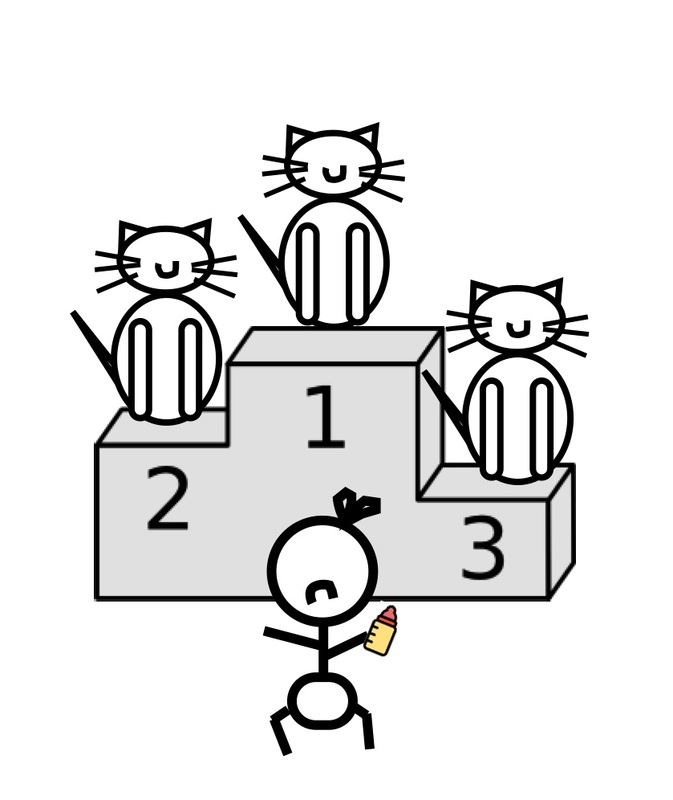
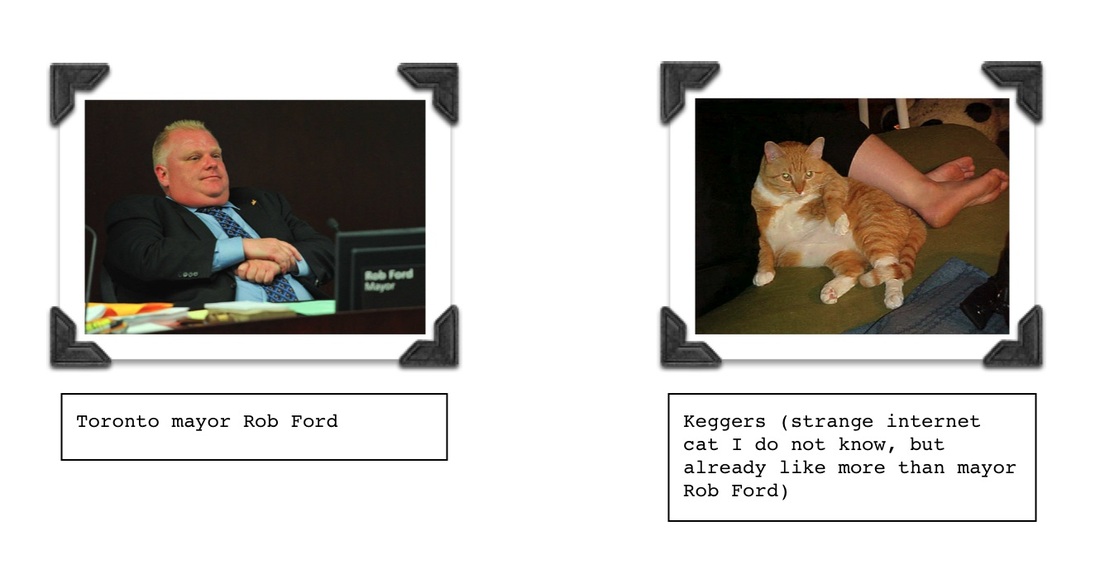
Let me begin by saying that I think it's wonderful that other people have babies. I think babies are great. I would willingly, if not delightedly, die for my nieces, who are the best young people who have ever existed. I like my friends' babies. I just don't ever, ever want to have any myself, while I spend much of almost every day dreaming of the cat I will soon get and watching internet videos of strange cats I do not know posted by strange people I do not know. Here's why I will always come down on the side of cats in the great cat vs. baby war:
1) I don't like most people, but I like almost every single cat I meet. Babies can be adorable. They can be tiny and sweet and make tiny, sweet noises and they have such little, chewable feet. And then their noises get louder and their feet get bigger and they become people, and you might find out that that teeny, tiny, adorable baby has turned out to be kind of an asshole. Kittens are also tiny and adorable, and then they grow into older cats, who are still pretty small and pretty adorable. If some of the cats I've known had been people, I might not have liked them one bit. But they weren't people; they were cats. And so the reasons I wouldn't have liked them if they were human are expressed in totally cat-ly ways that I find fetching or perverse or a bit quirky, but always completely enchanting. 2) Your cat, unless someone leaves the door open accidentally, can't just up and leave you. Your cat will never go off for a year in Paris after high-school, discover an irritating love for France, stay there forever, marry a French person and make a new life for herself far, far away. You cat will never say to you, "I know you're old and lonely, and that most of your friends have died, but I can only see you once a year at Christmas because my French job is so demanding and I have my own family now, you know." And if your cat were to do all that, give that cat a medal. That would be one awesome cat. I dare you to stay mad at a cat like that.
3) You're allowed to keep your cat shut up in the house all the time to keep him from harm. It's not that I don't love children. One of the reasons I don't want children is that I would love them in such a neurotic, smothering, terrified/terrifying way that as soon as they could, they would move to Paris. If I had a child, I would worry constantly and unhelpfully about food additives, and cars, and diseases, and chlamydia, and disappointments, and the things they put in plastics that make fish all messed up. If I tried to keep my child inside, if I told my child, "Nope. Sorry. There are too many hazards out there - get friendly with this house because it's where you will be spending THE REST OF YOUR LIFE," some interfering friend, relative, or neighbour, would undoubtedly interfere.
If you tell your cat that the one-bedroom apartment you have will be his only kingdom until death, your cat will a) not understand you, because he can't understand a huge number of words, and b) without realizing it owe you a debt, because you're making sure he won't be hit by a car or get stuck in a tree or get some kind of horrible raccoon-borne plague. Your friends, relatives, and neighbours will not care one bit that your cat can't go outside, or that you worry so much about your cat going outside, and the only thing you run the risk of is that they'll talk behind your back about how the reason you love your cat so much is that you never had any children.
POLITE DISCLAIMER: This site is intended for entertainment purposes only. If you are not entertained, fair enough.
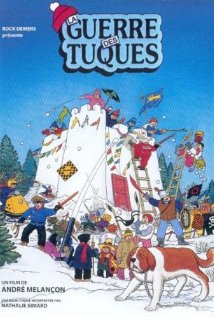
I recently watched the last half of a movie I never imagined I'd watch the first or last half of ever again: Harry and the Hendersons. It's not the worst movie ever, and I was happy to watch it rather than Mark Harmon being all stern (he was busy being stern on almost every other channel I get), but I suppose it was an hour I could have devoted to, say, reading Proust. Or something like that.What I didn't expect was that watching John Lithgow being humanized by a giant, kind-eyed big-foot would send me hurtling into a vortex of pain - childhood movie pain. Harry and the Hendersons, you see, reminded me for some ridiculous reason of a film I saw back in 1984 - a terrible, no-good, very bad film that made me very, very sad when I was eight years old.WARNING: What you are about to read is full of spoilers. It is pretty much made up only of spoilers. Why you would be upset to find out things about movies you could have seen hundreds of times over since the 1980s, I don't know, but there it is. And if you have seen either of these movies (I'm going to talk about another one, too, because remembering the misery caused by watching the first one reminded me of the misery caused by watching the second one) hundreds of times, you are a terrible, terrible person who wants to support filmmakers who make young, sensitive, imaginative girls cry their hearts out. Also, by "spoilers", I mean "plot points I'm pretty sure I remember having been part of the plots of these movies, but that I may, in fact, have made up because I was under ten years old when I saw the movies, and my memory is not very reliable."So. In 1984, I saw Iceman. I just looked it up on Imdb and discovered it was directed by a man named Fred Schepisi, who looks like a cross between a jolly uncle and Freddy Krueger and went on to make things like Roxanne, Six Degrees of Separation, and, naturally, Mr. Baseball. Iceman starred Timothy Hutton, and John Lone, and Lindsay Crouse (Riley's boss from the Initiative [Buffy]). Here's the Imdb summary:"An anthropologist who is part of an arctic exploration team discovers the body of a prehistoric man who is still alive. He must then decide what to do with the prehistoric man and he finds himself defending the creature from those that want to dissect it in the name of science."That's right. There is a lovely prehistoric man who is very confused but wants to be friends with people, and a couple of decent scientists who respect life and feelings, and then there are EVIL, HEARTLESS science-y people who want to torture this poor, confused, friendly creature in order to learn things. Here's where my memory gets a bit hazy. For some reason, this man hates the sound of helicopters. And after a whole lot of "But he's a living creature! He deserves respect!" and "He could advance the cause of human knowledge! He must be dissected!" he is hanging out in his enclosure, the bad science people bring in a helicopter for some reason, and he freaks out, jumps off something and dies. He just dies. And all the kids watching learn a little something about moral ambiguity, and the suffering of innocents, and how life is tragic and awful and tragic.Remembering how inconsolable and angry I was at the end of this movie reminded me of how inconsolable and angry I was at the end of another movie. This one was called The Dog Who Stopped the War (or La guerre des tuques), and it was also released in 1984. That year was one that made me very sad, apparently. The film poster makes the whole thing look like an adorable cuddle-fest: Snow-fort fun! Winter hijinks! A big, goofy, lovable dog! Here's the Imdb plot summary (which I suspect was translated from a different language, probably French):
"During Christmas' holidays, the children of a village split in two gang to play a snowball war. But that half-tone war scattered some bitterness and make more difficult the mutual attirance between Luc, the chief of the assailant and Sophie one leader of the snow castle defenders."
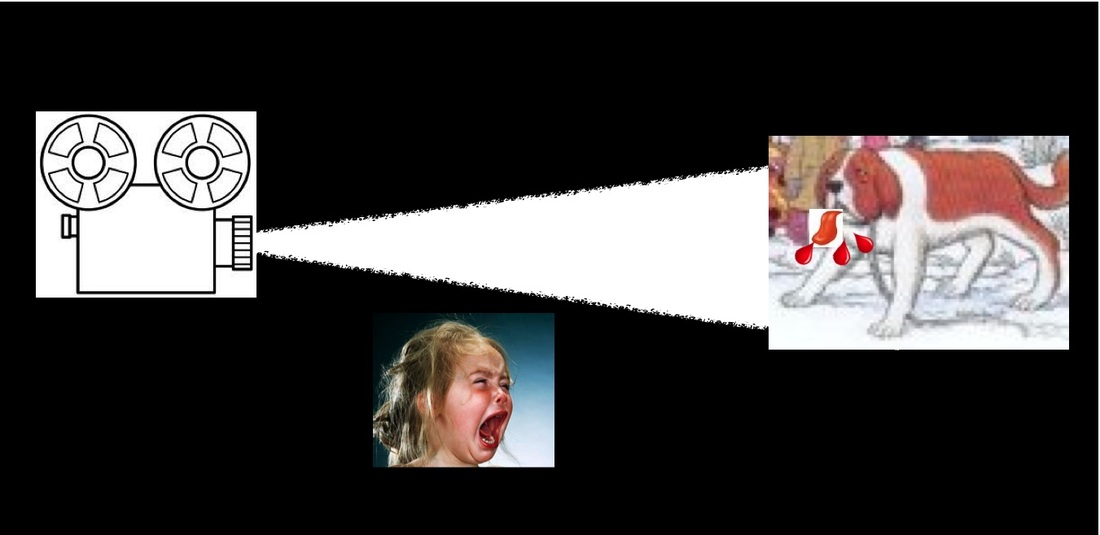
The kids have a snowball fight. They build giant snow fortresses. They start kind of hating each other. There is a big, goofy, lovable dog. The children become more and more hateful and competitive and vicious. THE BIG, GOOFY, LOVABLE DOG IS CRUSHED BY A COLLAPSING SNOW-FORT AND DIES. The children realize that they have become hateful and competitive and vicious and decide never to fight again BECAUSE THEY KILLED THE DOG.
I believe I saw this in the theatre at someone's birthday party. During the closing credit sequence, all you could hear was the sound of dozens and dozens of young children weeping. One of those children was I. I knew those snowball-throwing kids were taking it all too seriously. Throughout the movie, I was thinking, "Come on, guys. You should learn to cooperate and be nice to one another." I already knew that kids shouldn't fight and be mean. THE DOG DIDN'T HAVE TO DIE.
Thank God for the arrival of 1985 and movies like Back to the Future, which was only upsetting because I kept thinking Marty McFly was going to make out with his mother.
POLITE DISCLAIMER: This site is intended for entertainment purposes only. If you are not entertained, fair enough.
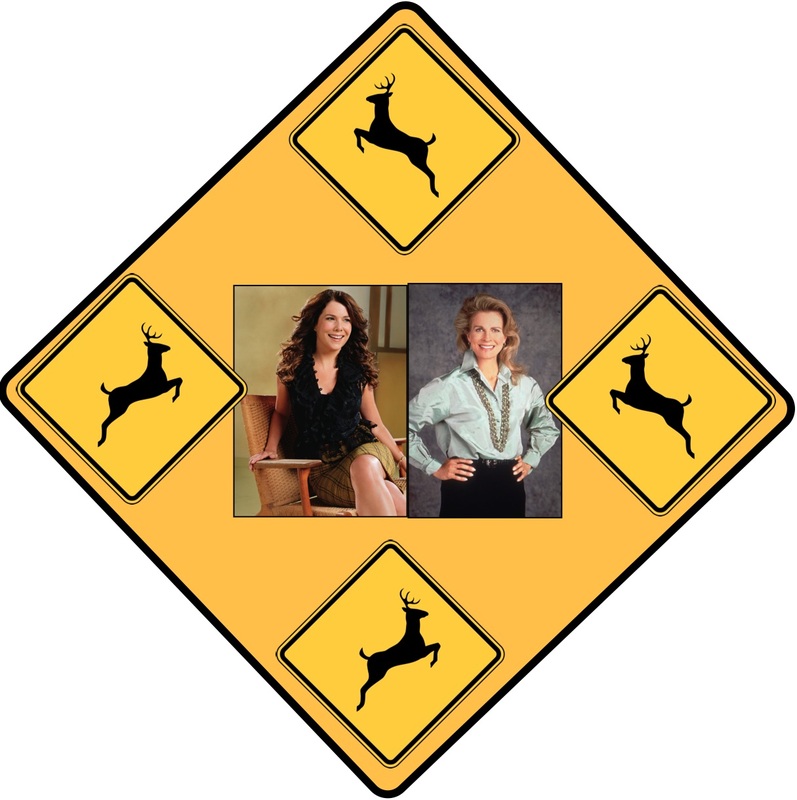
A concerned reader brought the following concerning news item to my attention: "Moins de chasseurs à cause des mères monoparentales, dit le sénateur Boisvenu".As my French has gone the way of my regard for Tom Selleck (as a man - as Magnum I still regard him frequently) and my youthful idealism, I turned to Google Translate and discovered that that jumble of delightfully nonsensical-sounding words means something along the lines of: "Fewer hunters because single mothers, said Senator Boisvenu". As you know, I have always believed that single mothers have a lot to answer for. They threaten to unravel the moral fabric of the nation. They are obviously an affront to all decently-married people. They also often have to work really hard to raise children alone, making the more morally-upstanding and decently-married of us appear shiftless and lazy. I have to thank Conservative Quebec senator Boisvenu for alerting me to this latest threat, and to Google, for translating this alert: "Noting the presence of more and more of mothers in society who are single parents, Senator Quebec has stated that 'hunting is no longer a tradition handed down from father to son,' adding that now, 'who is 14-15-16-17-18 years no longer have the reflex to purchase a firearm.'" "'We see that the number of hunters has made dramatic,'" he concluded.Senator Quebec, though, is not simply mourning the loss of a tradition; he is bringing attention to a new menace. "He said that if the deer are not slaughtered in the Eastern Townships, there are good times and bad, between 5000 and 8000 collisions between animals and cars. 'It leads to other problems in terms of mortality,' he said." So single mothers, then, by not passing down a reflex for the purchase of firearms to their sons, are directly responsible for road fatalities in that it is through their negligent mercifulness that the deer remain alive to kill.We can only hope that single mothers, now aware of this situation, will take responsibility for it, defend tradition, and save lives by purchasing weapons for their sons and teaching them to stalk and kill. POLITE DISCLAIMER: This site is intended for entertainment purposes only. If you are not entertained, fair enough. Also, I'm not very good at copy-editing, so if something looks wrong, it was put there by axident.
|



 RSS Feed